
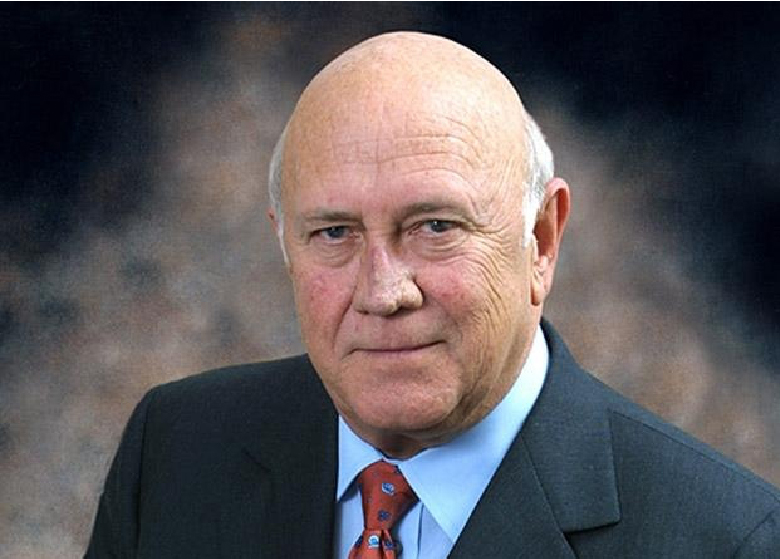
Frederik Willem (FW) de Klerk (90 yo)
Biography
Frederik Willem de Klerk, the last president of apartheid South Africa, passed away peacefully at his home in Cape Town on November 11, 2021, at the age of 85. He was a complex and controversial figure, but his role in dismantling the oppressive system of racial segregation that had defined South Africa for nearly half a century is undeniable.
Born into a prominent Afrikaner political family, de Klerk entered politics in 1972, following in the footsteps of his father, Jan de Klerk, who served as Minister of the Interior under Prime Minister Hendrik Verwoerd, the architect of apartheid. De Klerk rose through the ranks of the National Party (NP), the ruling party of apartheid South Africa, eventually becoming its leader in 1989.
When de Klerk took office, South Africa was in the throes of a deep political crisis. The anti-apartheid movement was gaining momentum, and the country was increasingly isolated from the international community. De Klerk recognized that the status quo was unsustainable and that apartheid had to be dismantled.
In a series of landmark speeches and actions, de Klerk initiated a process of reform that would eventually lead to the end of apartheid. He unbanned the African National Congress (ANC), the leading anti-apartheid organization, and released its imprisoned leader, Nelson Mandela. He also legalized political parties and repealed many of the apartheid laws that had restricted the rights of Black South Africans.
De Klerk's reforms were met with fierce resistance from hardliners within the NP and from white supremacist groups. However, he remained committed to his vision of a democratic South Africa, and he worked tirelessly to build a consensus for change.
In 1993, de Klerk and Mandela were jointly awarded the Nobel Peace Prize for their efforts to end apartheid. The following year, South Africa held its first free and fair elections, in which the ANC won a landslide victory. Mandela was elected president, and de Klerk served as his deputy until 1996.
After leaving office, de Klerk continued to work for peace and reconciliation in South Africa. He established the F.W. de Klerk Foundation, which promotes democracy and human rights around the world. He also wrote a memoir, "The Last Trek: A New Beginning," in which he reflected on his experiences as a leader during South Africa's transition to democracy.
Frederik Willem de Klerk was a flawed man, but he was also a courageous and visionary leader who played a pivotal role in transforming South Africa from a pariah state into a democracy. His legacy will be debated for years to come, but there is no doubt that he will be remembered as one of the most important figures in South African history.
In addition to his role in dismantling apartheid, de Klerk is also remembered for:
His commitment to peaceful negotiation and reconciliation His willingness to challenge the status quo and his own deeply held beliefs His unwavering belief in the power of democracy and human rights De Klerk's life and work are a testament to the power of human transformation and the possibility of change, even in the face of seemingly insurmountable odds.